

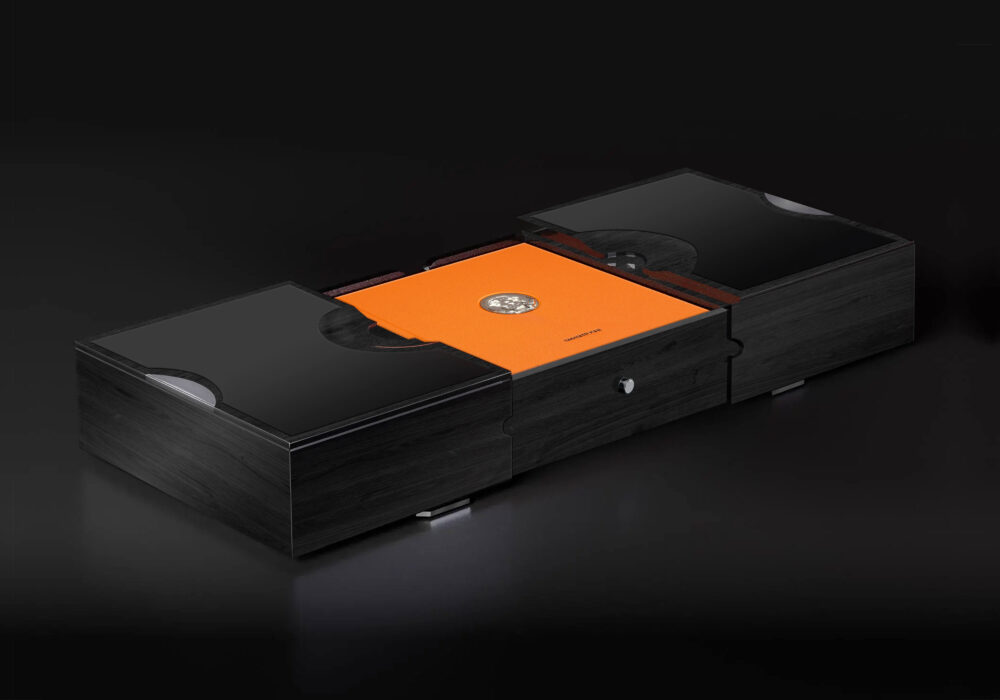
Limited edition book production is about more than printing. It’s the process of designing and engineering a physical object that doesn’t yet exist. This project explores that process in depth — how bespoke book production can move beyond conventional formats, combining materials, structure and craftsmanship to create something entirely new. While the design establishes the concept, it’s the production process that defines how the book is ultimately experienced.
This work sits within our broader approach to bespoke coffee table book design, where concept and execution are developed together from the outset. This project involved a large number of contributors and was produced in a way that pushed well beyond standard book-making. The challenge wasn’t the content, but the physical reality of doing justice to the ambition behind it.
What follows isn’t a description of the finished limited-edition book (you can explore that separately), but a look at the decisions, constraints, and problem-solving that sat quietly behind it.
Designing a bespoke book without templates
From the outset, this project resisted familiar book-making logic. In the context of limited-edition book production, the ambition wasn’t simply scale or quality – it was the combination of depth, weight, materials and precision engineering, all contained within a single object. That immediately ruled out off-the-shelf approaches. Standard formats, bindings and presentation boxes could not support the outcome without compromise. Instead, every element had to be designed from first principles – developed specifically for this project rather than adapted from existing solutions.



Engineering complex book binding systems
Lay-flat binding is often described as a feature of a book. In this case, it became a structural challenge. At conventional page counts, lay-flat binding is a well-understood approach, allowing pages to open fully without losing imagery into the spine. However, at 60mm depth, the physical weight and thickness of this book introduced entirely different stresses.
Traditional casing methods would have placed strain on the spine at every page turn – strain that, over time, would lead to failure. The question was no longer how to achieve a lay-flat result, but how to allow the book to function reliably at this scale.
The solution involved rethinking the book as a system. Weight distribution, structural tolerance and pressure points were all reconsidered to allow the pages to open freely without forcing the spine to absorb unnecessary stress.
This level of engineering is rarely visible. It only becomes noticeable when it’s missing – yet it is fundamental to serious limited-edition book production.
Paper as a curatorial tool in book production
With 128 artworks, uniformity would have been the easiest route – one stock, one finish, repeated throughout. It would have simplified the book production process and ensured consistency, but it would also have flattened the experience. The artworks themselves were hugely diverse: created by 128 different artists, each carries its own visual language, from very simple works to highly complex ones. Applying a single treatment would have given everything the same surface, flattening the differences that really matter to how each artwork should be seen.
Our challenge was how to let that diversity exist without the book losing its coherence. Paper became a curatorial tool, with texture, surface and print treatment chosen to suit the character of each work. The final publication brings together a carefully balanced range of papers – from beautifully tactile, toothy stocks to rough and smooth textures, through to pearlescents and high-gloss metallics. These are paired with an equally considered mix of printing techniques, including metallic and holographic foils, UV varnish and flock printing.
This introduced complexity at every stage – from print planning to collation – but it also introduced pace, contrast, and rhythm. The book slows you down in places. That was intentional.
The role of packaging in limited-edition books
In limited-edition book production, the box is rarely just protective packaging. It’s part of the experience, shaping the first physical interaction with the work before a single page is turned. For the First Edition, everything began with a simple question: what should the act of opening feel like? Not how it should look, but how it should feel. That thinking shaped the box’s materials and mechanics. Through multiple rounds of prototyping, this led to a mechanised opening system in which, at the press of a button, the doors open simultaneously – smoothly, quietly, and without drama.
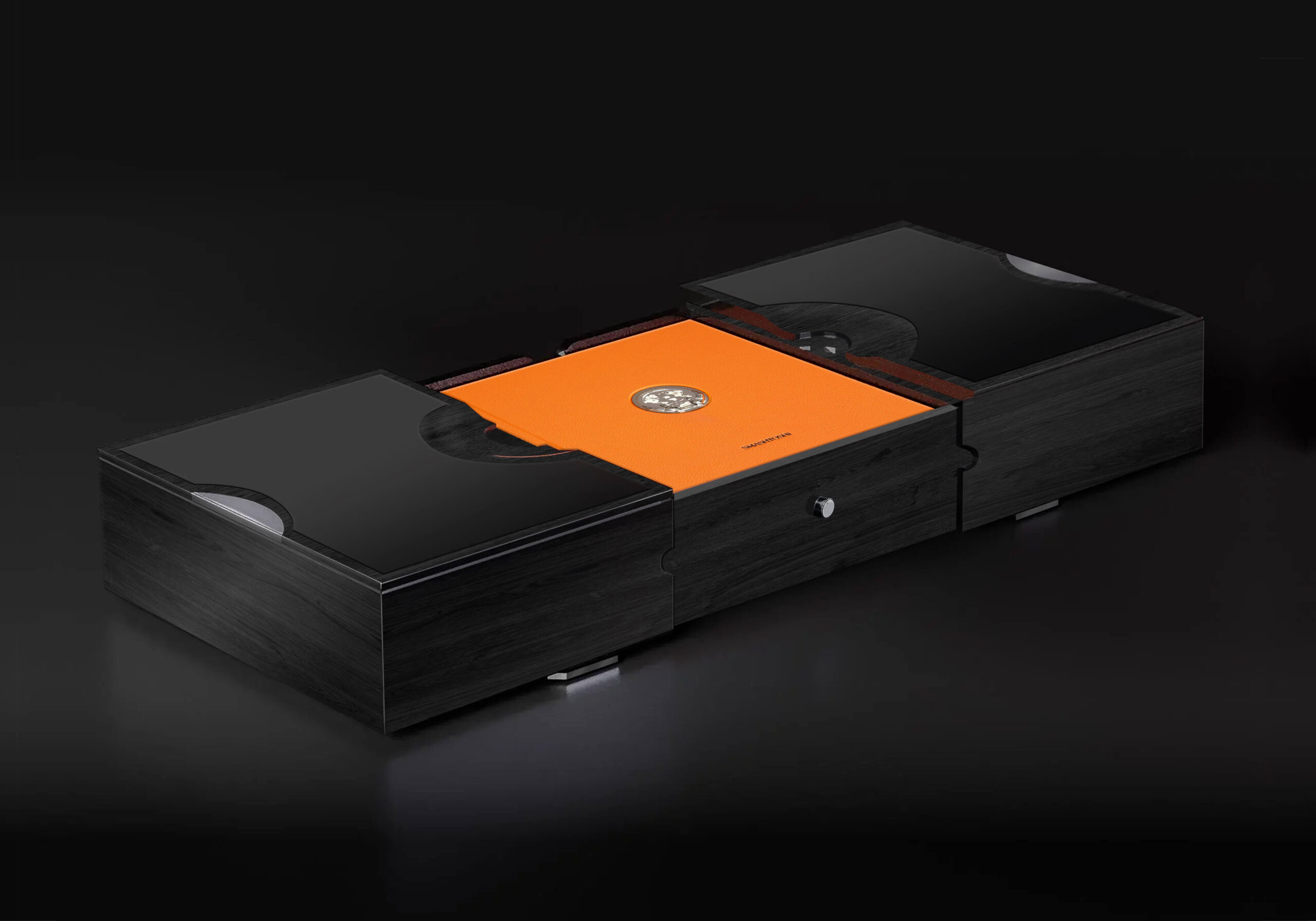
The finished box open, revealing the orange bull-leather book in contrast to the polished black oak exterior
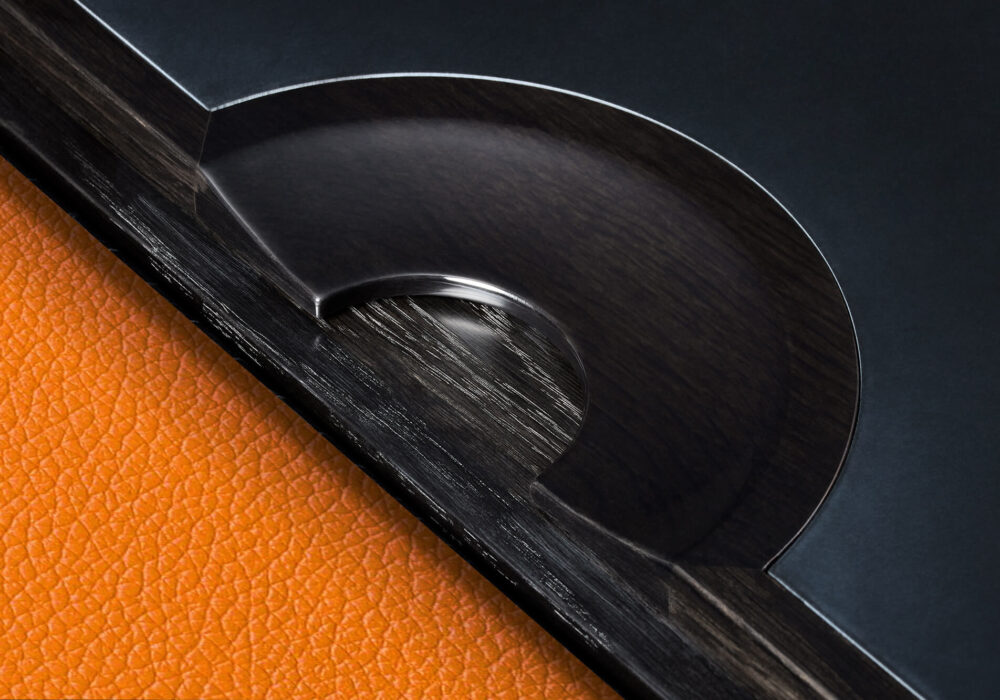

A rare approach to bespoke book packaging
The decision to make the First-Edition book box from 5,000-year-old black oak wasn’t about novelty, it was about time – working with a material that already carried age and scarcity, and allowing those qualities to quietly echo the principles behind the project itself.
Black oak is not stained or treated timber, but oak that has spent thousands of years preserved in peat bogs, where minerals and the absence of oxygen slowly darken and densify the wood. The process cannot be replicated or accelerated – it happens only through time. Once extracted, black oak must be carefully stabilised to prevent cracking and distortion as it adjusts to modern conditions. This work requires specialist knowledge and slow, controlled handling, undertaken by craftspeople experienced in working with material of this age.

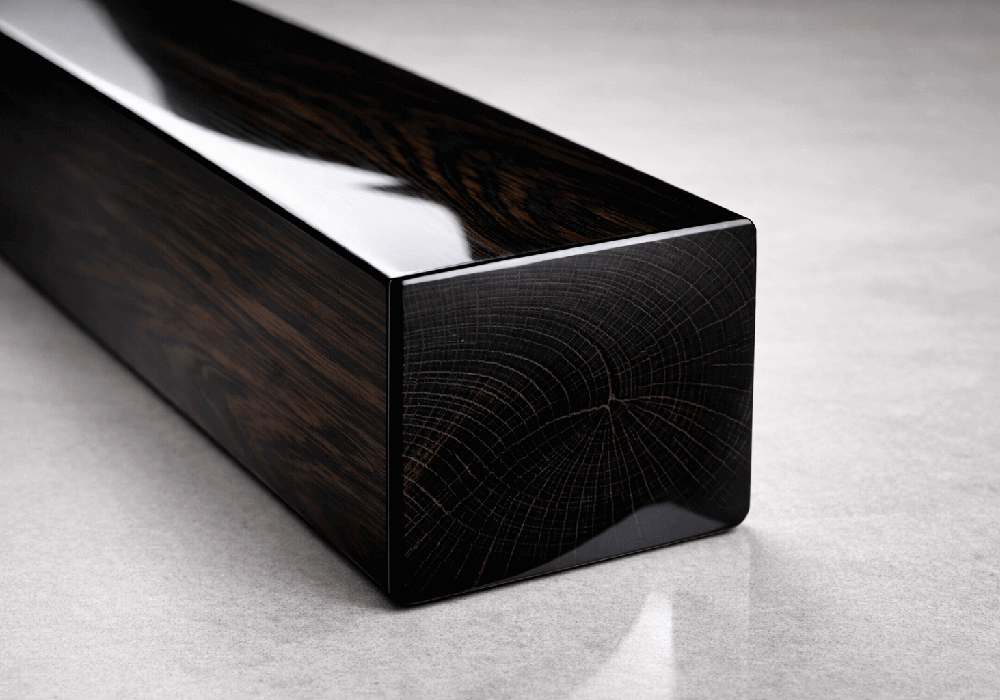
The unseen process behind limited-edition book production
Much of the work on complex book projects like this doesn’t photograph well. It lives in prototypes that failed, tolerances adjusted by millimetres, and materials tested and rejected.
This is the quieter side of limited-edition book production. A significant amount of time is spent long before anything looks resolved – testing, adjusting, revisiting decisions and allowing problems to surface early rather than later. That work is never seen by the people who eventually see the book, and it’s often not fully visible to our clients either. But it’s what allows everything else to feel calm, deliberate and resolved. When it’s done well, the result doesn’t draw attention to the effort behind it – it simply feels right, not because it was easy, but because the hard thinking has already happened behind the scenes.
To explore the project further, or acquire a Collector’s Edition, visit historyofbitcoin.io.